
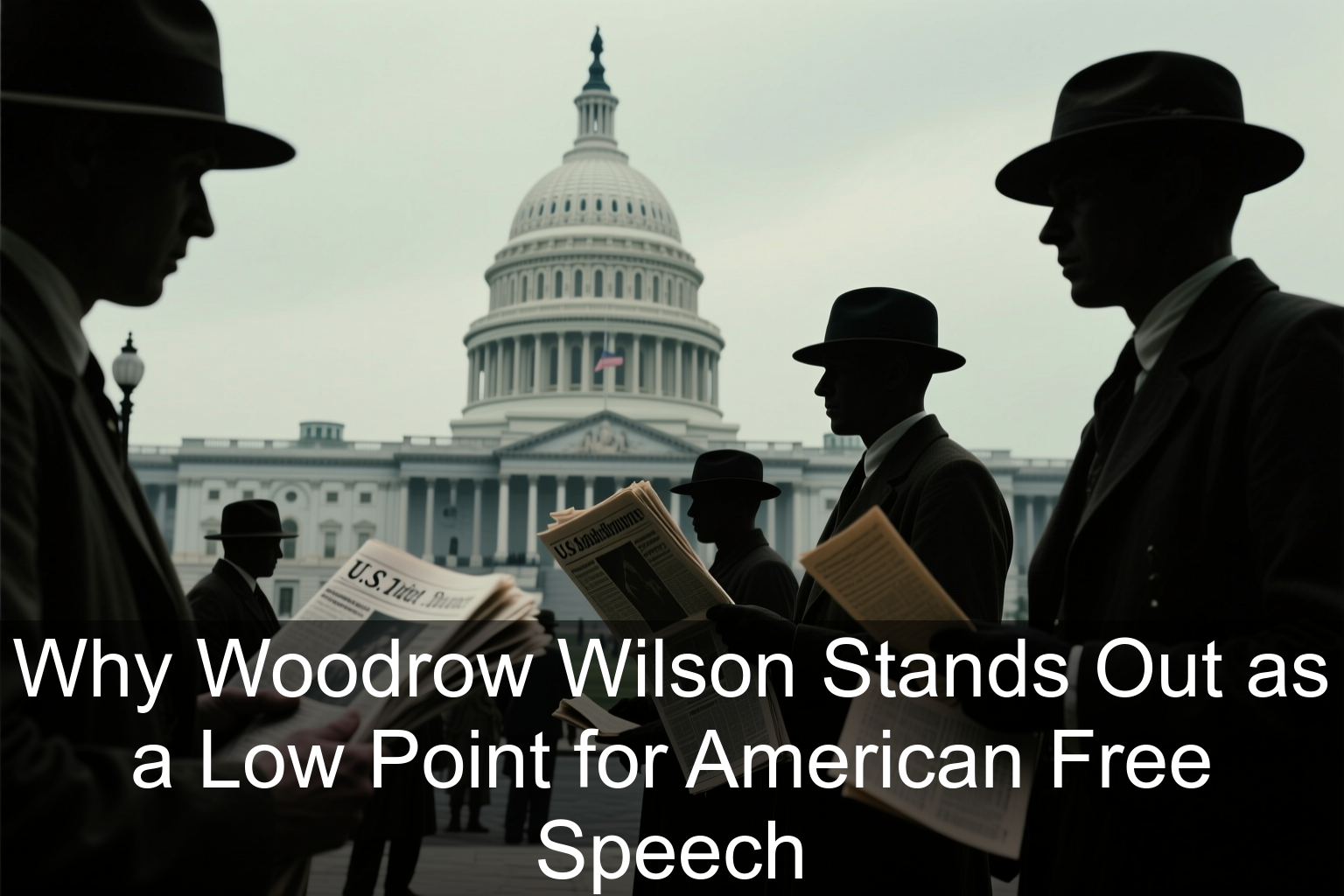

Long before modern debates over censorship and dissent, the United States experienced one of its most sweeping federal crackdowns on speech during Woodrow Wilson’s presidency. In the view advanced by the Foundation for Individual Rights and Expression, Wilson’s administration represents an especially damaging chapter for civil liberties because federal power was used aggressively to punish political criticism and suppress antiwar expression.
Wilson entered office at a moment when the country was moving toward deeper involvement in World War I, and the federal government’s approach to domestic opposition hardened as wartime pressure increased. Instead of treating harsh criticism as part of democratic self-government, the administration helped build a legal and political environment in which dissent was treated as disloyalty, and dissenters were targeted through prosecutions and other forms of government pressure.
Central to that effort were federal laws and enforcement campaigns aimed at speech. The Espionage Act and the later Sedition Act became tools for pursuing people whose words challenged the war effort or the government itself. Rather than focusing narrowly on genuine espionage, enforcement reached into ordinary political advocacy and criticism, allowing federal authorities to bring criminal cases over statements, pamphlets, and organizing that would normally fall within the bounds of protected political debate.
The administration’s posture was reinforced by a broader campaign that blended official prosecution with social and institutional coercion. Public dissenters, labor activists, and antiwar voices faced investigations, intimidation, and punishment, creating a climate in which citizens could reasonably fear that speaking openly might bring legal trouble or other serious consequences. In practice, the government’s message was clear: opposition to federal policy, especially in wartime, could be treated as a punishable offense.
This period is often remembered as a stress test for the First Amendment, and the Wilson years are frequently cited as an example of how quickly basic freedoms can be narrowed when leaders claim extraordinary circumstances. From a libertarian and conservative civil-liberties perspective, the lesson is not limited to history: the same arguments used then to justify suppression—public safety, national unity, emergency—can be repurposed in new forms unless free speech principles are defended consistently, especially when they protect unpopular views.
Leave a Reply