
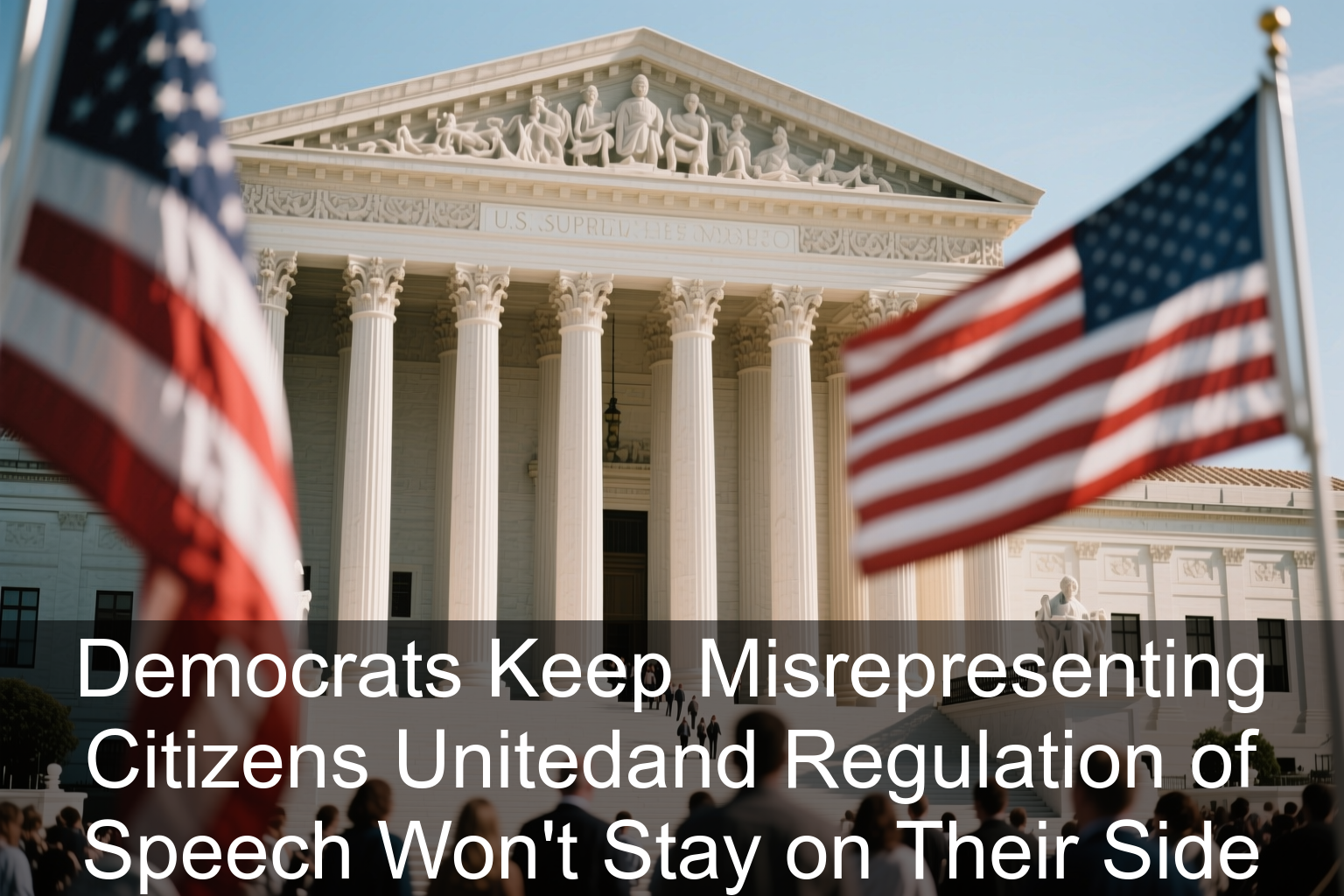

More than a decade after the Supreme Court decided Citizens United, the case is still routinely described in a way that doesn’t match what the ruling actually did. In today’s political arguments, it is often treated as a convenient villain for everything people dislike about campaign politics, even when the facts and legal limits of the decision say otherwise.
At its core, the dispute was about whether the government could restrict political communication based on the speaker’s identity. The Court concluded that political speech does not lose constitutional protection simply because it comes from a corporation or an organized association. That outcome is frequently recast as a special privilege for big companies, but the principle is broader: the First Amendment protects the right to speak about elections, and the government cannot pick and choose who is allowed to participate.
Critics on the left often connect Citizens United to the growth of outside spending and then argue that sweeping new limits are needed to “fix” democracy. But that pitch depends on portraying the decision as if it authorized direct donations to candidates or removed all guardrails. The ruling addressed independent political expenditures, not direct contributions to campaigns, and it did not erase disclosure rules or existing contribution limits that are governed by separate legal standards.
The push to give government more power over political advocacy also carries a practical warning for people who think the regulators will always share their values. Once new speech controls exist, the same tools can be used by whichever party holds power. Rules written to curb one set of speakers can be turned against unions, nonprofit advocacy groups, grassroots organizations, and controversial movements—especially when enforcement is shaped by political appointees and shifting administrative priorities.
For Democrats and allied groups, it may feel tempting to expand government oversight in the belief that it will restrain ideological opponents and large donors. But empowering the state to decide which political messages are acceptable, who may fund them, and under what conditions is a gamble with basic freedoms. The long-run result is unlikely to be a neatly “cleaned up” political system; it is more likely to be a system where speech rights shrink and enforcement becomes another arena for partisan conflict.
Citizens United remains unpopular in many circles, and it is easy to score points by blaming it for broader frustrations about politics. Yet the recurring mischaracterizations matter because they shape policy proposals that would put government officials in charge of regulating political expression. From a free-speech perspective, that is not a reform—it is a transfer of power away from citizens and toward the very institutions that have the strongest incentive to protect themselves from criticism.
Leave a Reply