Tag: Supreme Court

  • Supreme Court Rejects Judge-Made Causes of Action and Treating Legislative History as Binding Law

    Supreme Court Rejects Judge-Made Causes of Action and Treating Legislative History as Binding Law

    The Supreme Court has once again emphasized a basic constitutional boundary: federal courts are not supposed to create new avenues for private lawsuits simply because a statute is important or a policy goal seems worthwhile. The dispute arose from a case centered on a threshold question that often determines everything else—who, if anyone, is entitled to sue to enforce federal law in the first place.

    At the heart of the matter was the difference between law enacted through the constitutional process and surrounding materials that are often cited to explain it. The Court’s approach underscored that what binds citizens, agencies, and courts is the statutory text that actually passed both houses of Congress and was signed into law (or enacted over a veto), not later arguments about what some legislators may have intended or hoped.

    The case did not remain a dry debate about doctrine. It became a sharp clash among members of the Court, most notably between Justice Amy Coney Barrett and Justice Ketanji Brown Jackson, over the role legislative history should play. Their exchange highlighted a long-running divide: whether committee reports, floor statements, and similar records should be treated as meaningful guidance—or whether elevating such material risks converting selective political commentary into something approaching enforceable law.

    From a conservative and libertarian standpoint, the Court’s insistence on limiting judicially invented lawsuits reflects an effort to keep lawmaking where the Constitution places it. Allowing courts to infer private rights of action not clearly provided by Congress can expand federal power indirectly, inviting litigation-driven policymaking and empowering judges and agencies at the expense of elected lawmakers and the public’s ability to hold decision-makers accountable.

    By keeping the focus on enacted text and resisting the temptation to treat legislative history as controlling, the Court signaled that legal obligations should be knowable from the law itself rather than from a sprawling record of materials that are often incomplete, strategically curated, or contested. Whatever one thinks of the policy outcomes in any particular case, the ruling and the Barrett–Jackson dispute together underscored a foundational principle: in a system of separated powers, courts interpret the law that Congress wrote, not the law others wish Congress had written.

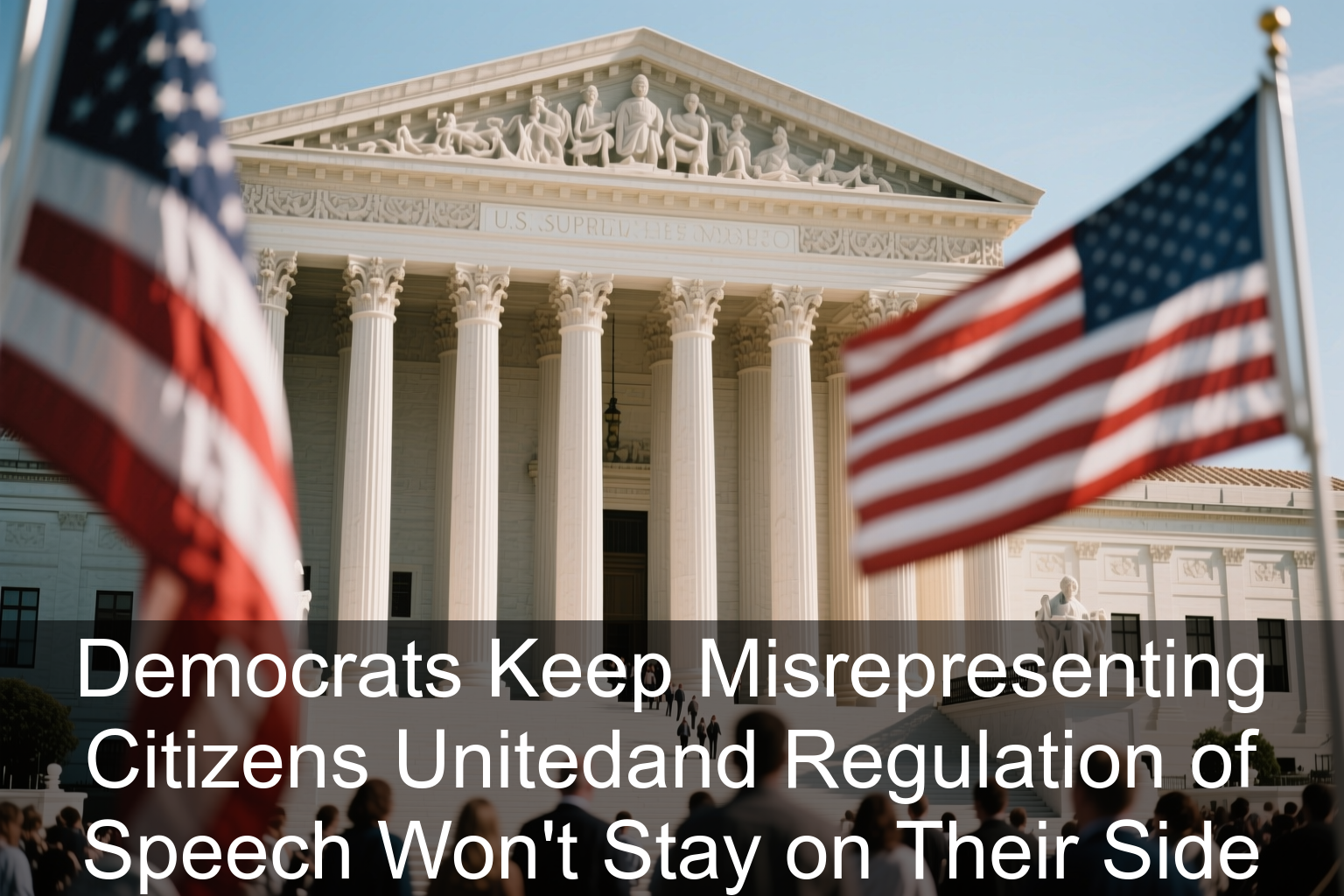
  • Democrats Keep Misrepresenting Citizens United—and Regulation of Speech Won’t Stay on Their Side

    Democrats Keep Misrepresenting Citizens United—and Regulation of Speech Won’t Stay on Their Side

    More than a decade after the Supreme Court decided Citizens United, the case is still routinely described in a way that doesn’t match what the ruling actually did. In today’s political arguments, it is often treated as a convenient villain for everything people dislike about campaign politics, even when the facts and legal limits of the decision say otherwise.

    At its core, the dispute was about whether the government could restrict political communication based on the speaker’s identity. The Court concluded that political speech does not lose constitutional protection simply because it comes from a corporation or an organized association. That outcome is frequently recast as a special privilege for big companies, but the principle is broader: the First Amendment protects the right to speak about elections, and the government cannot pick and choose who is allowed to participate.

    Critics on the left often connect Citizens United to the growth of outside spending and then argue that sweeping new limits are needed to “fix” democracy. But that pitch depends on portraying the decision as if it authorized direct donations to candidates or removed all guardrails. The ruling addressed independent political expenditures, not direct contributions to campaigns, and it did not erase disclosure rules or existing contribution limits that are governed by separate legal standards.

    The push to give government more power over political advocacy also carries a practical warning for people who think the regulators will always share their values. Once new speech controls exist, the same tools can be used by whichever party holds power. Rules written to curb one set of speakers can be turned against unions, nonprofit advocacy groups, grassroots organizations, and controversial movements—especially when enforcement is shaped by political appointees and shifting administrative priorities.

    For Democrats and allied groups, it may feel tempting to expand government oversight in the belief that it will restrain ideological opponents and large donors. But empowering the state to decide which political messages are acceptable, who may fund them, and under what conditions is a gamble with basic freedoms. The long-run result is unlikely to be a neatly “cleaned up” political system; it is more likely to be a system where speech rights shrink and enforcement becomes another arena for partisan conflict.

    Citizens United remains unpopular in many circles, and it is easy to score points by blaming it for broader frustrations about politics. Yet the recurring mischaracterizations matter because they shape policy proposals that would put government officials in charge of regulating political expression. From a free-speech perspective, that is not a reform—it is a transfer of power away from citizens and toward the very institutions that have the strongest incentive to protect themselves from criticism.

  • Swatting Reported at Justice Amy Coney Barrett’s Home, Renewing Safety Concerns for Conservatives

    Swatting Reported at Justice Amy Coney Barrett’s Home, Renewing Safety Concerns for Conservatives

    Reports say a swatting call targeted the residence of Supreme Court Justice Amy Coney Barrett, the latest episode in a broader pattern of threats and harassment directed at prominent conservatives. Swatting typically involves a false emergency report intended to trigger an armed police response, placing occupants and responding officers at risk.

    The incident is being discussed as part of a continuing climate in which political disagreement has spilled into intimidation tactics. Commentators note that when false reports are used to send law enforcement to a private home, the danger is immediate and indiscriminate, affecting families, neighbors, and public safety personnel alike.

    In conservative and libertarian circles, the episode is also being framed as another consequence of heated rhetoric from national leaders. In that view, language that treats political opponents as illegitimate can encourage unstable actors to escalate from online hostility to real-world threats, even if those leaders did not direct a specific act.

    Justice Barrett has been a frequent subject of political anger since joining the Supreme Court, and her position on major cases has made her a high-profile target. The reported swatting at her home adds to concerns that the rule of law is being strained by a culture that increasingly tolerates personal harassment as a substitute for lawful civic engagement.

    Advocates for stronger accountability argue that swatting should be treated as a serious crime, not a prank, because it weaponizes emergency services and creates a high risk of injury or worse. They also contend that public officials across the political spectrum should condemn intimidation tactics clearly and consistently, especially when they are aimed at judges whose role depends on independence and security.

  • Supreme Court Death Penalty Rulings Leave States Room to Execute the Intellectually Limited

    Supreme Court Death Penalty Rulings Leave States Room to Execute the Intellectually Limited

    Capital punishment remains constitutionally permissible in the United States, and recent debates over the Supreme Court’s approach highlight how much discretion states still have when seeking executions. Critics on the right argue that, whatever people think about the death penalty as policy, the Court’s Eighth Amendment framework has not created a clear constitutional barrier to executing offenders who have low intelligence but are not legally exempt.

    At the center of the controversy is the claim that the Constitution does not categorically prohibit putting to death “dumb guys who kill people,” a blunt formulation meant to separate intellectual limitation from the narrow legal protections that have developed around specific diagnoses or thresholds. From this perspective, the legal system is not designed to excuse murder based on general cognitive weakness, particularly when juries and courts have concluded that a defendant is culpable for a deliberate killing.

    The Supreme Court’s death-penalty jurisprudence, as portrayed by commentators taking a conservative or libertarian view, is often criticized for being uneven and heavily dependent on shifting judicial standards rather than stable constitutional text. The result, they contend, is a system that leaves states navigating complex rules while still permitting executions in cases that some advocates would prefer to remove from the table through broader constitutional interpretation.

    Supporters of a tighter reading of the Eighth Amendment emphasize that the Court’s role is not to impose a national moral judgment about who is “too limited” to execute beyond the categories already recognized in law. They argue that decisions about punishments, including whether the death penalty should exist at all, are principally questions for legislatures and voters, not for judges to resolve by expanding constitutional doctrine.

    In that view, the current landscape produces a harsh reality for defendants with low intelligence who nonetheless fall outside formal exemptions: they can still face capital sentences and, ultimately, execution. The continuing dispute is less about whether the death penalty is allowed in general and more about how far constitutional protections extend—and whether the Court should keep drawing and redrawing lines that determine who lives and who dies.

  • Why the Supreme Court Should Pause the FDA’s Abortion-Pill Rule Until the Agency Follows the Law

    Why the Supreme Court Should Pause the FDA’s Abortion-Pill Rule Until the Agency Follows the Law

    The dispute over the abortion drug commonly known as the “abortion pill” has shifted from politics to process, raising a question that matters beyond this one medication: whether a federal agency should be allowed to expand its reach without first demonstrating that it has satisfied the legal and scientific obligations that justify its authority. The argument for a judicial pause is not that courts should micromanage medicine, but that agencies should be required to show their work before their decisions are allowed to reshape national policy.

    At the center of the debate is the Food and Drug Administration’s role as a regulator that exists to evaluate drugs through defined standards, not to act as a shortcut for policy outcomes. When an agency changes rules affecting how a drug is prescribed and distributed, it is supposed to be able to explain the basis for those changes in a way that can withstand scrutiny. From a conservative and libertarian perspective, that accountability is essential: the administrative state should not be permitted to exercise broad power first and provide a convincing justification later.

    Supporters of a stay argue that the Supreme Court should require the FDA to meet its responsibilities before its rule takes effect in a way that is difficult to reverse. A stay, in this view, is a temporary safeguard designed to prevent an agency from entrenching a contested regime while basic questions about lawful procedure, evidence, and the scope of delegated authority remain unsettled. The point is not to pre-judge the ultimate merits of the medication itself, but to insist that the government follow the rules that restrain it.

    This line of reasoning also reflects a broader concern about how modern governance works. When agencies can effectively make major policy through regulatory adjustments—especially in an area as divisive as abortion—citizens are left with fewer meaningful checks on unelected decision-makers. Conservatives tend to see that as a constitutional problem, and libertarians tend to see it as a limit-on-power problem; either way, both camps generally agree that institutions should not be rewarded for bypassing the discipline of careful, transparent decision-making.

    In that framework, the Supreme Court’s role is to ensure that power is exercised within boundaries, not to substitute its own preferences for those of regulators. A stay would signal that the FDA cannot rely on its status alone, and that it must demonstrate it has done its job before it is allowed to wield the sweeping practical effects that accompany a nationwide rule. The underlying claim is straightforward: if an agency wants deference, it should first earn it by following the law and providing a rigorous, reviewable explanation for its actions.