News Updates

  • Saudi Arabia and the UAE: Washington’s Key Gulf Partners Drift Toward Rivalry

    For years, American strategy in the Middle East has leaned heavily on two pillars in the Gulf: Saudi Arabia and the United Arab Emirates. Both governments are central to U.S. security cooperation, energy interests, and regional diplomacy. Yet their relationship is increasingly defined not only by coordination, but by competition that could complicate Washington’s approach to the region.

    The shifting dynamic matters because Riyadh and Abu Dhabi are not peripheral players. They have the resources, influence, and ambition to steer outcomes far beyond their borders. When their interests align, they can amplify stability and deter common threats. When they diverge, their rivalry can reshape alliances, policy choices, and the balance of power across the Middle East.

    At the heart of the issue is a growing Saudi–UAE rivalry that is poised to influence the region’s next chapter. These two partners have demonstrated they can work together, but they are also pursuing distinct national priorities and competing visions for leadership in the Gulf. That tension, rather than any single dispute, is what raises the question of whether they are moving toward a more direct strategic collision.

    From a conservative and libertarian vantage point, the trend is a reminder of the limits of outsourcing U.S. regional goals to even the closest partners. The United States benefits when allies share burdens, but it also pays a price when allied competition pulls Washington into arbitrating disputes or choosing sides. A sounder approach emphasizes clear, narrowly defined U.S. interests, disciplined commitments, and a refusal to treat any partnership as a blank check.

    How this rivalry evolves will help determine the future Middle East. If Saudi Arabia and the UAE manage their competition responsibly, the region could see more predictable cooperation among key states. If the contest intensifies, it may generate new friction points that test U.S. diplomacy and expose the risks of assuming that shared partnerships automatically translate into shared priorities.


  • Art Fairs, Sky-High Masterpiece Prices, and What Markets Reveal

    Art Fairs, Sky-High Masterpiece Prices, and What Markets Reveal

    The contemporary art economy often looks irrational from the outside, yet it keeps delivering clear signals about what people value and what they are willing to pay for. In today’s market, the biggest names can command extraordinary sums, and those numbers ripple outward, shaping everything from what galleries show to what collectors chase.

    Recent pricing for marquee works has again demonstrated how extreme the top end can be. Paintings by Jackson Pollock and Mark Rothko have reached stratospheric levels, reinforcing a long-running reality: scarcity, reputation, and buyer competition can combine to push a small set of objects far beyond what most people would ever imagine spending on art.

    That atmosphere is part of what makes the circuit of art fairs so influential. Fair “hopping” has become a practical way for buyers to compare offerings quickly, for dealers to meet demand in one concentrated place, and for the industry to reinforce consensus about who and what matters. In a sector where taste is subjective but prices are not, the fair floor functions like a rapid feedback loop, sorting attention and capital in real time.

    At the same time, much of what draws viewers has little to do with price tags and everything to do with experience. Exhibitions that emphasize eerie, empty, or “ghostly” spaces continue to find an audience, as do works that frame the ocean in a way that feels elevated or “sublime.” These subjects offer something markets can’t fully quantify—mood, memory, and the emotional pull of place—while still participating in the same system of buying and selling.

    Materials and craft are also asserting themselves in ways that complicate the old hierarchy between “fine art” and textiles. The medium of yarn, in particular, is being used to powerful effect, showing how technique and labor can carry meaning just as strongly as paint and canvas. Even in a world where blue-chip names can dominate headlines, the broader scene keeps reminding observers that innovation and impact are not limited to any single medium.

    From a conservative and libertarian standpoint, the art world’s contradictions are not proof of failure but evidence of freedom at work. People are free to assign value, take risks, and spend their own money on what speaks to them—whether that means a record-setting Pollock or a quiet room of spectral architecture, a sweeping seascape, or a piece built from yarn. The results will always look uneven, but the process is transparent in its own way: voluntary exchange, decentralized judgment, and prices that reflect actual demand rather than official decree.

  • Trump Targets GOP Rivals in Primaries as Colbert Ends His Run

    Trump Targets GOP Rivals in Primaries as Colbert Ends His Run

    Republican politics this week revolved around a familiar dynamic: Donald Trump using the primary season not only to shape the party’s future but also to settle accounts from past fights. The former president’s influence over candidate fields and endorsements continued to define key contests, reinforcing the reality that many Republican hopefuls still calibrate their plans around his preferences and his grievances.

    Across the primary map, Trump’s involvement functioned as a kind of party sorting mechanism. Candidates who previously positioned themselves against him, or who were associated with intra-party efforts to curb his power, faced renewed pressure as Trump-aligned forces worked to elevate challengers and squeeze dissenters. The overall effect was to keep the Republican electorate focused on loyalty, leverage, and the lessons drawn from the last several cycles.

    For conservatives and libertarians watching the broader implications, the pattern raises practical questions about what the party is prioritizing during a cycle that will also demand clear arguments on inflation, spending, border enforcement, energy policy, and the administrative state. When primaries become proxy battles over personal history, it can narrow the space for policy-centered debate and reduce incentives for candidates to build coalitions beyond the most engaged partisan voters.

    The week’s political storyline also unfolded alongside a notable media development: Stephen Colbert signed off. His departure marked the end of a high-profile chapter in late-night television, a format that has increasingly blended entertainment with political messaging. For many on the right, Colbert’s run symbolized how prominent cultural platforms can shape perceptions of conservatives and Republican voters, often through a lens that feels less like satire and more like sustained ideological critique.

    Taken together, the political and cultural notes of the week underscored how power in American life is negotiated in more than one arena. In the Republican primaries, Trump’s continued prominence showed that the party is still working through unresolved internal conflicts. In media, the end of Colbert’s tenure highlighted shifting dynamics in an industry that has long served as a megaphone for political attitudes—and a battleground over who gets portrayed fairly.

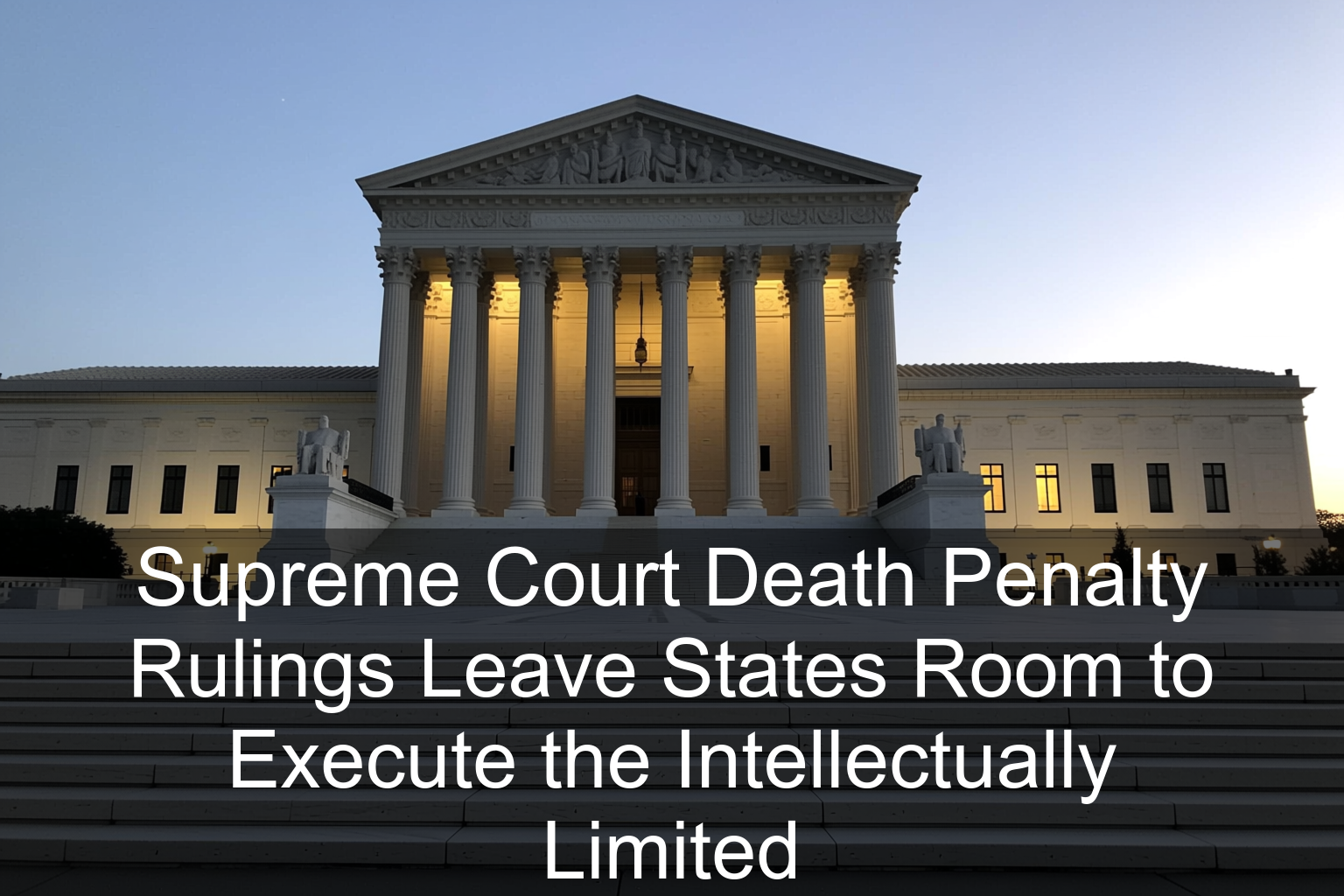
  • Supreme Court Death Penalty Rulings Leave States Room to Execute the Intellectually Limited

    Supreme Court Death Penalty Rulings Leave States Room to Execute the Intellectually Limited

    Capital punishment remains constitutionally permissible in the United States, and recent debates over the Supreme Court’s approach highlight how much discretion states still have when seeking executions. Critics on the right argue that, whatever people think about the death penalty as policy, the Court’s Eighth Amendment framework has not created a clear constitutional barrier to executing offenders who have low intelligence but are not legally exempt.

    At the center of the controversy is the claim that the Constitution does not categorically prohibit putting to death “dumb guys who kill people,” a blunt formulation meant to separate intellectual limitation from the narrow legal protections that have developed around specific diagnoses or thresholds. From this perspective, the legal system is not designed to excuse murder based on general cognitive weakness, particularly when juries and courts have concluded that a defendant is culpable for a deliberate killing.

    The Supreme Court’s death-penalty jurisprudence, as portrayed by commentators taking a conservative or libertarian view, is often criticized for being uneven and heavily dependent on shifting judicial standards rather than stable constitutional text. The result, they contend, is a system that leaves states navigating complex rules while still permitting executions in cases that some advocates would prefer to remove from the table through broader constitutional interpretation.

    Supporters of a tighter reading of the Eighth Amendment emphasize that the Court’s role is not to impose a national moral judgment about who is “too limited” to execute beyond the categories already recognized in law. They argue that decisions about punishments, including whether the death penalty should exist at all, are principally questions for legislatures and voters, not for judges to resolve by expanding constitutional doctrine.

    In that view, the current landscape produces a harsh reality for defendants with low intelligence who nonetheless fall outside formal exemptions: they can still face capital sentences and, ultimately, execution. The continuing dispute is less about whether the death penalty is allowed in general and more about how far constitutional protections extend—and whether the Court should keep drawing and redrawing lines that determine who lives and who dies.

  • A Self-Guided Look at Manhattan’s Revolutionary-Era Landmarks, from Trinity Church to the Morris-Jumel House

    A Self-Guided Look at Manhattan’s Revolutionary-Era Landmarks, from Trinity Church to the Morris-Jumel House

    Lower Manhattan still carries visible reminders of the country’s early political and military struggles, and a walk through the area makes clear how closely New York’s streets are tied to America’s founding era. The stops are familiar to many visitors, yet they also serve as a practical lesson in how history survives when a city chooses to preserve it.

    One key destination is Trinity Church, a landmark that anchors the story downtown and offers a direct connection to the period when the nation’s institutions were taking shape. Nearby is the grave of Alexander Hamilton, a site that draws attention not only because of Hamilton’s outsized role in early American finance and governance, but also because it sits in the middle of a modern city that often treats its past as optional.

    The route then shifts from monuments and memorials to the harder realities of wartime decision-making. George Washington’s fight for control of Manhattan remains central to understanding why the city mattered strategically, and why the island became a focal point during the Revolutionary War. The contest for Manhattan highlights the founding generation’s constraints—limited resources, difficult terrain, and the stakes of defending a crucial position.

    Moving uptown changes the atmosphere, but it does not leave the past behind. The Morris-Jumel House comes into view as another preserved window into early New York, offering a different kind of encounter than a churchyard or battlefield story. It stands as a reminder that private spaces can be as historically revealing as public ones, especially when they are maintained rather than replaced.

    The stop at the Morris-Jumel House also carries a lighter, local note: the lingering question of whether a ghost might still be associated with Jumel Terrace. Whatever one makes of that tradition, the larger point is straightforward—New York holds layers of American history across neighborhoods, and protecting those places keeps the city’s story accessible to ordinary people rather than locking it away in archives.

  • Lawsuit Alleges Nevada School Expelled Student Over Pro-ICE Stickers in Viewpoint Dispute

    Lawsuit Alleges Nevada School Expelled Student Over Pro-ICE Stickers in Viewpoint Dispute

    A newly filed lawsuit says a Nevada school removed a student from campus because of stickers expressing support for Immigration and Customs Enforcement, raising a fresh dispute over whether schools are policing opinions rather than behavior. The complaint frames the discipline as punishment for a political message, not a response to any concrete disruption.

    According to the suit, the student displayed emblems described as “pro-ICE” and was expelled after school officials objected to the viewpoint those stickers conveyed. The legal filing characterizes the school’s response as discrimination based on the student’s perspective, arguing that the punishment targeted the student’s stance rather than any rule applied evenly across differing views.

    The case comes amid ongoing national debates about how far school authority reaches when student expression touches on contentious public issues. Supporters of broad free-speech protections argue that political messages, including unpopular ones, are precisely the kind of expression that should be safeguarded in educational settings, absent specific, demonstrable interference with school operations.

    From a civil-liberties and limited-government perspective, the allegations highlight a familiar concern: institutions with coercive power can be tempted to regulate speech by labeling certain opinions as unacceptable. If the lawsuit’s claims are accurate, the dispute is less about stickers than about whether students are allowed to hold and express lawful political positions without being singled out for punishment.

    The lawsuit asks the court to treat the expulsion as an unlawful act of viewpoint-based discipline. As the case proceeds, the central question will be whether the school can justify its actions on neutral, consistently applied grounds, or whether the record supports the claim that the student was expelled specifically because of the pro-ICE message.

  • GOP’s Next Youth-Focused Culture Fight Is Likely to Fail

    GOP’s Next Youth-Focused Culture Fight Is Likely to Fail

    Republicans appear to be gearing up for another political campaign that is designed to resonate with younger voters inside the party. The effort is being framed as a new front in the broader struggle over culture, identity, and institutional influence, with an emphasis on what party leaders and aligned organizations believe the next generation should prioritize.

    The push is aimed squarely at the party’s youth, seeking to shape how younger conservatives understand politics and where they direct their energy. Rather than concentrating on concrete, limited-government reforms that can be translated into durable policy, the strategy leans toward a combative posture that treats the moment as a must-win battle for cultural dominance.

    From a conservative and libertarian perspective, that kind of approach often carries built-in weaknesses. When political capital is spent on symbolic fights, it tends to crowd out reforms that could actually shrink government, restore individual liberty, and make institutions more accountable through clear rules instead of moral crusades. It can also encourage centralized, top-down thinking—the very style of politics that the right typically argues against when it comes from the left.

    There is also a practical political problem: efforts that are constructed primarily as generational messaging projects can struggle to last. Young voters are not a monolith, and they are particularly skeptical of campaigns that feel like branding exercises rather than serious governing agendas. If the movement’s main objective is to rally and recruit, it risks neglecting the hard work of building coalitions around achievable, measurable outcomes.

    If Republicans want a more durable path, the better option would be to anchor outreach to younger conservatives in a clear defense of free expression, open debate, and pluralism—paired with a serious commitment to fiscal restraint and limits on state power. A youth-oriented initiative that prioritizes liberty and competence over performative conflict would be more consistent with the right’s stated principles and more likely to endure than another short-lived war effort.

  • Trump’s Proposed “Anti-Weaponization” Fund Raises Questions About Political Influence and Equal Justice

    Trump’s Proposed “Anti-Weaponization” Fund Raises Questions About Political Influence and Equal Justice

    A new proposal associated with former President Donald Trump is drawing attention for what it signals about how politics and the legal system are colliding. The initiative has been described as an “Anti-Weaponization Fund,” a label that frames it as a response to claims that government power has been turned against political opponents. Supporters present it as a defense against politicized prosecutions and investigations, while critics argue it risks intensifying the same kind of institutional pressure it claims to oppose.

    From a conservative and libertarian perspective, the central concern is not whether politically motivated enforcement exists—many on the right believe it does—but whether answering one form of weaponization with another ultimately strengthens the worst incentives in the system. Once political actors normalize using fundraising, advocacy networks, and organized pressure to shape legal outcomes, the boundary between equal justice and factional advantage becomes harder to defend. That erosion can be especially damaging to constitutional norms that are supposed to restrain whoever holds power next.

    The fund’s concept also highlights an emerging pattern: political movements increasingly build quasi-institutional infrastructure to fight legal and administrative battles outside normal democratic channels. The idea resembles tactics long associated with progressive activism—coordinating legal support, messaging, and pressure campaigns in a way that turns courts and agencies into recurring arenas of partisan conflict. For limited-government advocates, that shift is troubling because it encourages politics to seep into places where neutrality and due process should be paramount.

    Critics of the proposal say the messaging is unusually blunt, suggesting that the effort is not merely a general-purpose civil-liberties project but a targeted political instrument. That candidness is part of what is fueling the backlash: opponents read the fund as an attempt to openly consolidate resources to influence how the justice system is perceived and, indirectly, how it behaves. Even some sympathetic observers worry that making such efforts explicit invites escalation from the other side, producing a cycle of retaliation that further corrodes public trust.

    A more restrained approach, many conservatives and libertarians argue, would focus on structural reforms that reduce the ability of any administration to politicize enforcement: clearer limits on prosecutorial discretion, stronger protections against selective investigation, transparency in agency decision-making, and accountability mechanisms that apply regardless of party. If the goal is truly to prevent “weaponization,” then the standard should be consistent and universal, not built around personalities or the immediate needs of a single political moment. The broader question raised by the fund is whether the country is moving toward a norm where every faction builds its own machinery to pressure the system—or whether leaders will recommit to rules that protect everyone, including their opponents.

  • Hantavirus Fears Are Overblown: Keep Perspective, Not Panic

    Hantavirus Fears Are Overblown: Keep Perspective, Not Panic

    A fresh wave of alarm about hantavirus has been circulating, with some commentary implying the world may be on the cusp of another pandemic. That conclusion doesn’t hold up well against what’s actually known about how hantaviruses spread and how rarely they cause broad outbreaks. A sober look at the evidence points to a far more limited risk than the public rhetoric suggests.

    Hantaviruses are not new, and they are not typically efficient at moving through human populations. The main pathway for human infection is exposure to infected rodents or their droppings, urine, or saliva—often in enclosed or dusty spaces where contaminated particles can be inhaled. That means the risk is primarily environmental and situational, not the kind of fast person-to-person transmission that fuels global pandemics.

    Because the exposure route is so specific, infections tend to appear as isolated cases or small clusters tied to rodent contact rather than as expansive, self-sustaining outbreaks. Treating every uptick in attention as an indicator of an imminent worldwide emergency encourages public overreaction and distracts from the practical measures that actually reduce risk, such as basic sanitation, rodent control, and careful cleanup practices in areas where rodents may be present.

    The broader lesson is that public-health messaging works best when it respects proportionality. A free society depends on clear-eyed risk communication, not fear-driven narratives that can be used to justify sweeping mandates, emergency powers, or institutional overreach. The most responsible approach is to acknowledge that hantavirus can be dangerous for those infected while also recognizing that it is extremely unlikely to become the next pandemic.

    In other words, people should stay informed and take commonsense precautions without letting online panic substitute for real analysis. Measured awareness is compatible with liberty; mass hysteria is not. The facts support vigilance and personal responsibility—not another round of pandemic-style alarmism.

  • Virginia Assault-Firearm and Magazine Ban Sparks Wave of Lawsuits After Spanberger Signs Bill

    Virginia Assault-Firearm and Magazine Ban Sparks Wave of Lawsuits After Spanberger Signs Bill

    Legal challenges are quickly stacking up in Virginia following Gov. Abigail Spanberger’s approval of a new state law that prohibits many semi-automatic firearms and restricts ownership of standard-capacity magazines. The rapid move to the courthouse reflects how sharply divided Virginians remain over the scope of the Second Amendment and the proper limits of state power.

    At the center of the dispute is legislation that targets a broad category of commonly owned semi-automatic guns while also limiting magazines that hold what supporters of the law describe as “standard-capacity.” Critics argue that the measure is less about punishing criminal misuse and more about constraining ordinary citizens who follow the law, shifting the burden onto people who have done nothing wrong.

    The lawsuits contest the legality of the ban and seek to block enforcement, contending that Virginia is crossing constitutional lines by outlawing firearms and magazines that are widely possessed for lawful purposes. Opponents of the measure view the restrictions as a sweeping government intrusion that treats normal ownership as suspect and undermines the individual right to keep and bear arms.

    Supporters of these court fights say the immediate flood of litigation was predictable given the breadth of the restrictions and the political significance of gun policy in the Commonwealth. From a libertarian and conservative perspective, the key question is whether lawmakers can erase access to popular firearms by relabeling them and then claim public safety as a justification, despite the impact on peaceful residents.

    As these cases proceed, the outcome will shape how far Virginia can go in regulating firearms that operate semi-automatically and magazines that many gun owners consider standard equipment. For now, Spanberger’s signature has set off a high-stakes legal battle that will test the limits of state authority and the durability of constitutional protections for everyday Virginians.