
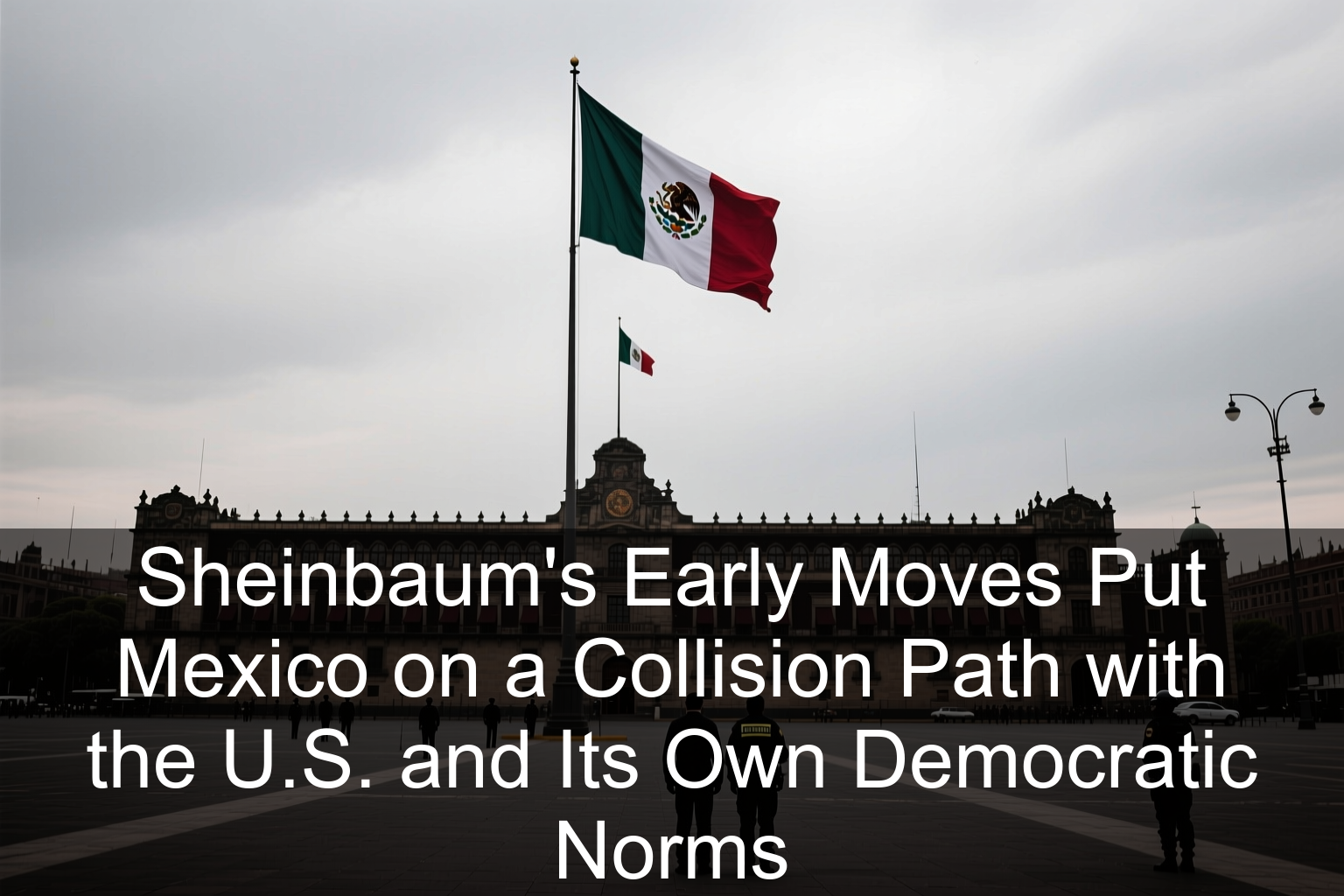

Mexico’s new president, Claudia Sheinbaum, is steering her administration into a confrontational posture that is reverberating beyond the country’s borders. The direction of travel, as her government takes shape, suggests a growing willingness to test limits both in Mexico’s democratic framework and in its relationship with the United States.
In Washington, the immediate concern is not only policy disagreement but the broader trajectory of Mexico’s governance. When a neighboring country with deep economic ties to the U.S. signals a readiness to challenge established rules and institutions, the fallout rarely stays contained. The friction is emerging early, before the normal rhythms of bilateral problem-solving can settle in.
At home, the more serious issue is institutional. The Sheinbaum government is being described as moving away from basic civic expectations in a democratic system—standards that rely on restraints, predictable rules, and respect for the structures that keep political power from becoming arbitrary. From a limited-government perspective, those guardrails are not abstract ideals; they are the practical protections that allow civil society, markets, and individual rights to function without constant political interference.
Taken together, these developments point to a governing approach that invites confrontation rather than compromise. A strategy that elevates conflict with external partners while straining domestic democratic norms risks narrowing Mexico’s room to maneuver. It can also make ordinary cooperation—on trade, security, and cross-border challenges—harder to sustain, because the underlying trust in stable governance starts to erode.
For Mexico and the United States alike, the stakes are structural, not merely partisan. If the new administration continues down a path that collides with U.S. interests while also weakening the civic foundations of Mexican democracy, the result could be a longer period of tension with consequences that reach into economic confidence, institutional legitimacy, and the day-to-day predictability that citizens and businesses depend on.
Leave a Reply