Tag: media

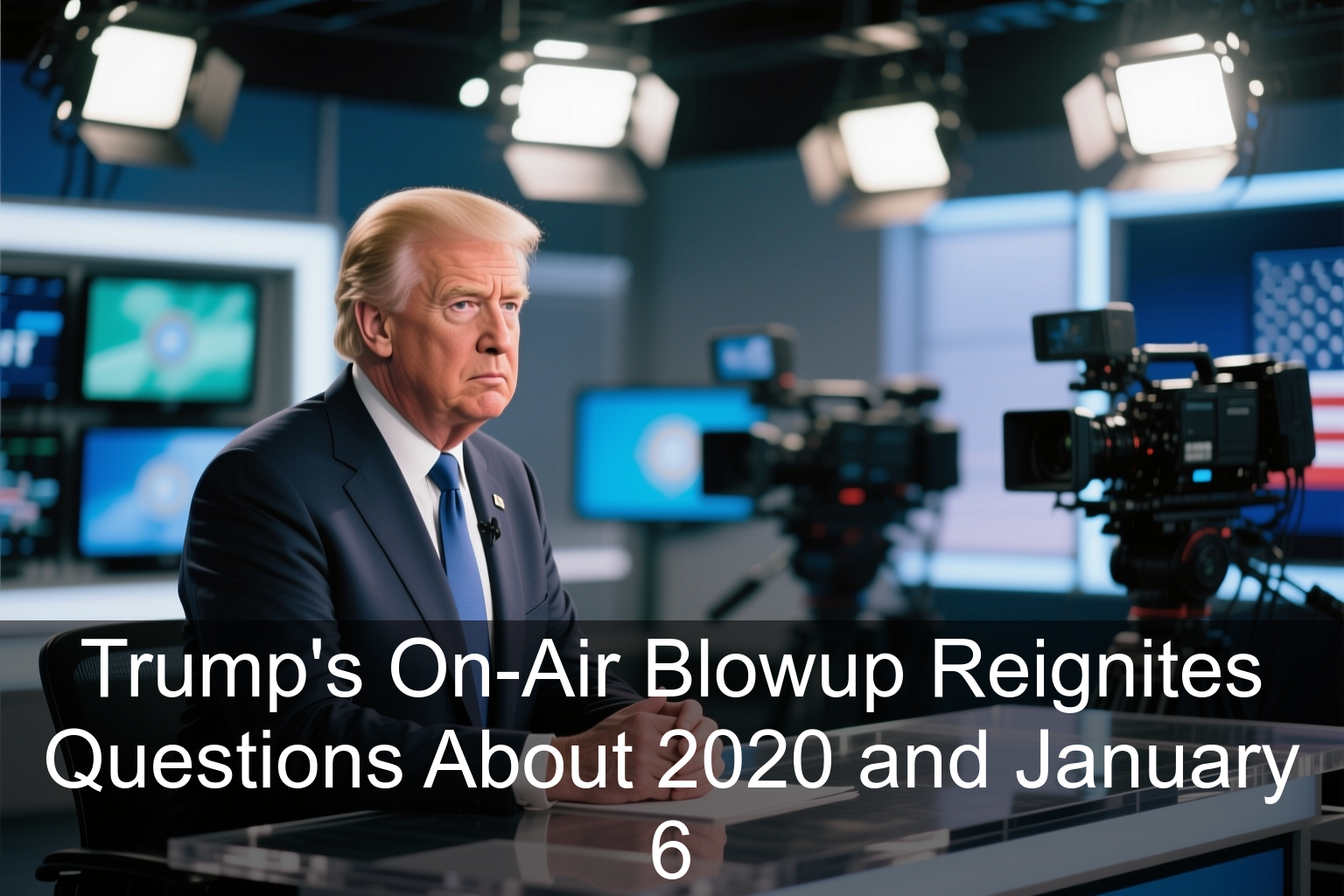
  • Trump’s On-Air Blowup Reignites Questions About 2020 and January 6

    Trump’s On-Air Blowup Reignites Questions About 2020 and January 6

    A recent televised exchange put President Donald Trump back in familiar territory: the unresolved disputes surrounding the 2020 election and the events of January 6. The segment quickly moved beyond routine political talk and became a window into how intensely Trump still reacts when those topics are raised in a public setting.

    Rather than treating the discussion as settled history, Trump returned to his long-running grievances and visibly bristled at challenges to his narrative. The moment underscored that, years later, the debate over what happened after the 2020 vote remains personally charged for him, especially when he is pressed in real time on camera.

    The exchange also illustrated a broader political dynamic. For many voters, January 6 and the aftermath of the 2020 election are issues they want leaders to address with clarity and restraint. Yet Trump’s performance suggested that these subjects continue to provoke a defensive posture, one that can overtake whatever strategic message he might otherwise want to deliver.

    From a conservative and libertarian standpoint, the spectacle is a reminder of how quickly politics can drift away from first principles—limited government, institutional accountability, and respect for the constitutional process—and into personality-driven conflict. When a president’s public focus repeatedly snaps back to past disputes, it can crowd out pressing questions about executive power, federal overreach, fiscal discipline, and the everyday concerns of citizens who want government to do less, not more.

    The on-air blowup, in that sense, was revealing not because it introduced new information, but because it highlighted how unsettled the president appears whenever the 2020 election and January 6 are brought to the forefront. For supporters and critics alike, the episode served as another signal that these events still occupy a central place in Trump’s public identity—and that the country is likely to keep revisiting them as long as he remains at the center of national politics.

  • JD Vance’s Image Makeover Keeps Falling Flat

    JD Vance’s Image Makeover Keeps Falling Flat

    Political figures often try to package themselves as relatable—someone who “gets it” beyond committee rooms and cable hits. In today’s media environment, that effort increasingly includes borrowing cues from pop culture, social media trends, and the aesthetics of “normal guy” authenticity. But there’s a limit to what branding can accomplish when it runs up against a politician’s record and temperament.

    Sen. JD Vance has leaned into that modern playbook, making repeated attempts to project an effortlessly appealing persona. The underlying bet is straightforward: if a politician can look comfortable and culturally fluent, it becomes easier to sell voters on bigger claims about leadership, values, and competence. Yet the more Vance seems to try to manufacture that vibe, the more forced it appears—especially to audiences who can tell the difference between organic confidence and a performance built for clips.

    From a conservative and libertarian perspective, this dynamic matters for more than gossip or aesthetics. The movement does not need leaders who chase cultural approval or treat politics as a contest in status-signaling. It needs people who can argue clearly for limited government, constitutional boundaries, and realistic foreign and domestic policy—without hiding behind a curated persona meant to distract from hard questions.

    There is also a strategic risk for the right when messaging becomes too focused on “coolness.” It can blur priorities and incentivize politicians to optimize for attention rather than outcomes. When style becomes the main event, voters are left with a thin substitute for accountability: a series of poses that may look fine on a screen but offer little guidance on how someone will govern.

    Vance’s experience illustrates how difficult it is to reverse-engineer broad appeal through presentation alone. A politician can swap talking points, adjust wardrobe, or adopt the social-media mannerisms of the moment, but public perception tends to harden around consistency, credibility, and character. In the end, the question isn’t whether a senator can win a fleeting cultural moment; it’s whether he can earn trust by being principled and competent when the cameras aren’t rolling.

  • Trump Targets GOP Rivals in Primaries as Colbert Ends His Run

    Trump Targets GOP Rivals in Primaries as Colbert Ends His Run

    Republican politics this week revolved around a familiar dynamic: Donald Trump using the primary season not only to shape the party’s future but also to settle accounts from past fights. The former president’s influence over candidate fields and endorsements continued to define key contests, reinforcing the reality that many Republican hopefuls still calibrate their plans around his preferences and his grievances.

    Across the primary map, Trump’s involvement functioned as a kind of party sorting mechanism. Candidates who previously positioned themselves against him, or who were associated with intra-party efforts to curb his power, faced renewed pressure as Trump-aligned forces worked to elevate challengers and squeeze dissenters. The overall effect was to keep the Republican electorate focused on loyalty, leverage, and the lessons drawn from the last several cycles.

    For conservatives and libertarians watching the broader implications, the pattern raises practical questions about what the party is prioritizing during a cycle that will also demand clear arguments on inflation, spending, border enforcement, energy policy, and the administrative state. When primaries become proxy battles over personal history, it can narrow the space for policy-centered debate and reduce incentives for candidates to build coalitions beyond the most engaged partisan voters.

    The week’s political storyline also unfolded alongside a notable media development: Stephen Colbert signed off. His departure marked the end of a high-profile chapter in late-night television, a format that has increasingly blended entertainment with political messaging. For many on the right, Colbert’s run symbolized how prominent cultural platforms can shape perceptions of conservatives and Republican voters, often through a lens that feels less like satire and more like sustained ideological critique.

    Taken together, the political and cultural notes of the week underscored how power in American life is negotiated in more than one arena. In the Republican primaries, Trump’s continued prominence showed that the party is still working through unresolved internal conflicts. In media, the end of Colbert’s tenure highlighted shifting dynamics in an industry that has long served as a megaphone for political attitudes—and a battleground over who gets portrayed fairly.

  • Why Progressives Are Quiet About Misinformation When It Helps Their Side

    Why Progressives Are Quiet About Misinformation When It Helps Their Side

    For years, progressive politicians, major media outlets, and many advocacy groups treated “misinformation” as an urgent public threat that demanded aggressive countermeasures. The idea was straightforward: false claims spread quickly online, so institutions should step in to slow them down, label them, or remove them. That posture, however, appears far less consistent when misleading narratives are useful to the left’s political interests.

    The shift is most visible in how accusations of misinformation are applied unevenly. When dubious claims come from conservatives, they are often presented as proof that tighter content controls are necessary. When similar problems originate from progressive circles, the reaction tends to be softer, more conditional, or redirected toward blaming opponents for “weaponizing” the issue. The result is a public standard that looks less like a principled commitment to accuracy and more like a partisan tool.

    This double standard is particularly striking given how recently many on the left demanded far-reaching action from technology companies. Platforms were urged to police speech more aggressively, and dissenting views were sometimes treated as inherently suspect. Yet in practice, enforcement and public condemnation frequently depend on which coalition benefits. When the messaging aligns with progressive goals, the urgency to correct errors can fade, and the same people who argued that misleading content is intolerable become comparatively reluctant to call it out.

    From a conservative and libertarian viewpoint, this inconsistency matters for two reasons. First, it undermines trust in institutions that claim to arbitrate truth while applying rules selectively. Second, it strengthens the case that centralized “disinformation” regimes are prone to political capture. If misinformation is truly the concern, then accuracy should be defended regardless of who gains from the correction. If the concern disappears whenever the wrong side is inconvenient to criticize, then the campaign was never mainly about truth.

    A more reliable approach is to treat misinformation as a universal human problem rather than a partisan talking point. That means demanding the same scrutiny for claims from any ideological camp, resisting speech controls that can be turned into political enforcement, and focusing on transparency and open debate. If the standard shifts depending on who is speaking, it becomes difficult to argue that the goal is honest information rather than advantage.

  • Online Left Reactions to the WHCD Assassination Attempt Drift into Speculation

    Online Left Reactions to the WHCD Assassination Attempt Drift into Speculation

    After the assassination attempt connected to the White House Correspondents’ Dinner, a predictable online pattern set in: political commentary rushed ahead of verifiable information. Instead of waiting for confirmed details, many prominent voices on the online left began offering confident narratives that were heavy on implication and light on support.

    A recurring feature of these explanations has been their detachment from evidence. Claims are often presented as if they are established facts, even when basic questions remain unanswered publicly. The result is a kind of parallel storyline—one built from assumptions, insinuations, and ideological reflex rather than documentation.

    From a conservative and libertarian perspective, this is more than a rhetorical problem. When political tribalism takes precedence over careful fact-finding, it undermines the public’s ability to assess risk, motive, and responsibility with clarity. It also encourages the idea that reality can be negotiated into whatever version best suits one’s preferred political conclusion.

    Another consequence is that the same people who regularly demand rigorous standards in other contexts appear willing to suspend those standards here. The online conversation becomes an “anything goes” arena, where speculation is rewarded and caution is treated as complicity or weakness. That dynamic makes it harder for accurate information to break through, because the most dramatic or convenient claim spreads faster than the most substantiated one.

    If there is a responsible way to respond to a political-violence incident, it starts with restraint: distinguish what is known from what is guessed, avoid laundering rumor into “common knowledge,” and recognize that assigning blame without evidence is not analysis. In moments like this, the public deserves fewer instant narratives and more patience for facts.