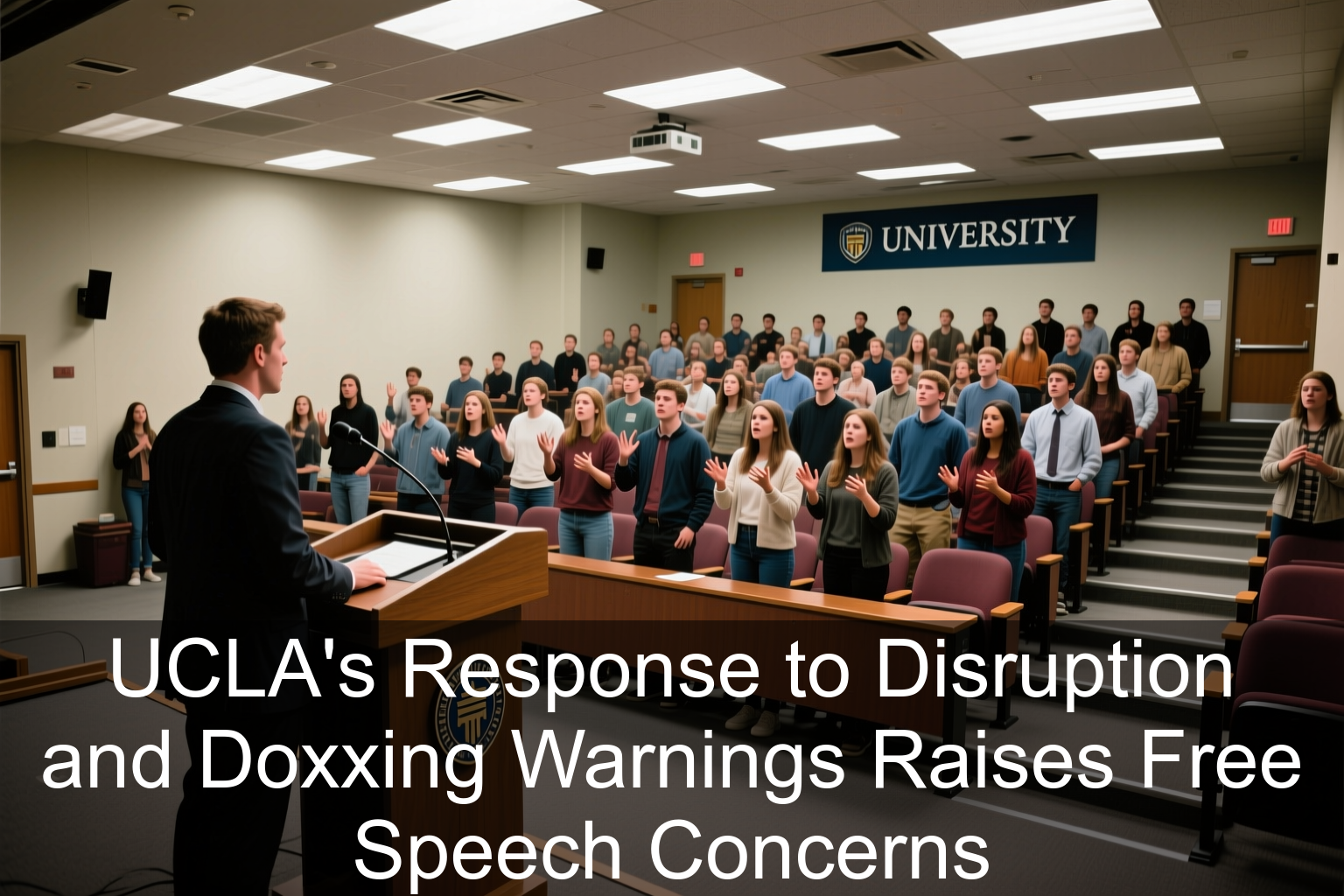
A recent incident at UCLA’s law school has reignited a familiar debate about campus speech rules: when protesters prevent a speaker from being heard, do administrators treat it as misconduct or as protected expression? The flashpoint involved a Department of Homeland Security official who appeared at the law school and was met with loud, coordinated interruptions from law students that stopped the event from proceeding normally.
After the disruption, attention shifted from the conduct inside the room to what happened online afterward. Video of the incident began circulating, and with it came attempts by some observers to identify the students involved. Rather than emphasizing accountability for those who shut down the event, UCLA administrators issued a warning aimed at critics, advising against naming or identifying the disruptors based on the footage.
That administrative response drew criticism because it appeared to prioritize shielding the interrupters from public identification over defending the basic expectation that invited speakers can deliver remarks without being drowned out. From a civil-liberties perspective, a university has an obligation to protect open inquiry and viewpoint diversity, especially at a public institution where First Amendment principles and due process norms carry particular weight.
The controversy also highlights a broader pattern in higher education: rules are often enforced unevenly depending on who is speaking and who is protesting. When disruptive tactics succeed, the practical result is a veto over campus events, encouraging future activists to replace debate with noise—an outcome that undermines the exchange of ideas a law school is supposed to model.
The episode at UCLA is now being discussed not only as a single case of protest crossing into disruption, but also as a test of administrative priorities. If the institution’s main message after an event is shut down is a caution to critics about identifying participants on video, many will see that as an inversion of responsibilities—one that risks normalizing “shout-down” tactics while discouraging public scrutiny of those who use them.