
Tag: separation of powers

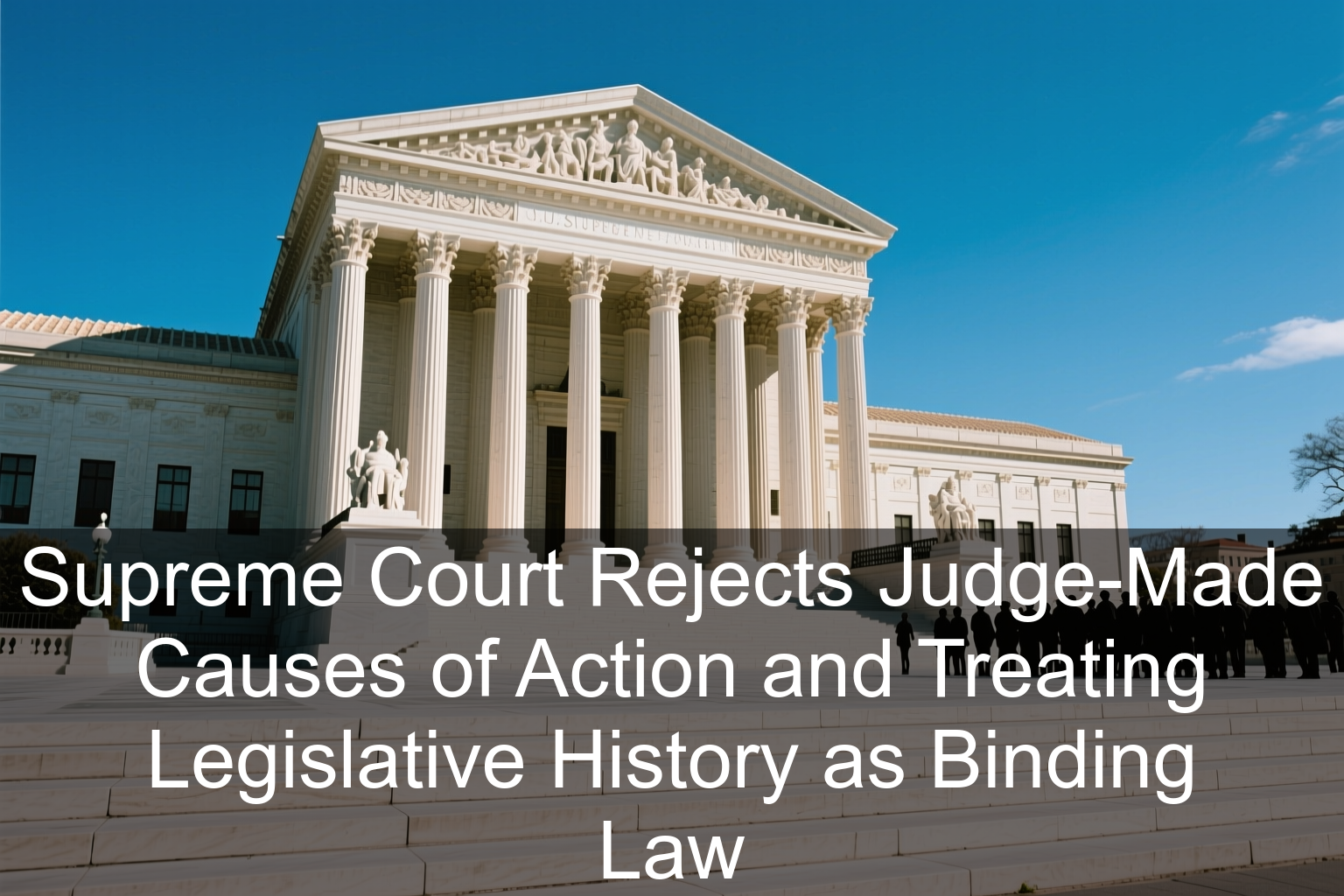
  • Supreme Court Rejects Judge-Made Causes of Action and Treating Legislative History as Binding Law

    Supreme Court Rejects Judge-Made Causes of Action and Treating Legislative History as Binding Law

    The Supreme Court has once again emphasized a basic constitutional boundary: federal courts are not supposed to create new avenues for private lawsuits simply because a statute is important or a policy goal seems worthwhile. The dispute arose from a case centered on a threshold question that often determines everything else—who, if anyone, is entitled to sue to enforce federal law in the first place.

    At the heart of the matter was the difference between law enacted through the constitutional process and surrounding materials that are often cited to explain it. The Court’s approach underscored that what binds citizens, agencies, and courts is the statutory text that actually passed both houses of Congress and was signed into law (or enacted over a veto), not later arguments about what some legislators may have intended or hoped.

    The case did not remain a dry debate about doctrine. It became a sharp clash among members of the Court, most notably between Justice Amy Coney Barrett and Justice Ketanji Brown Jackson, over the role legislative history should play. Their exchange highlighted a long-running divide: whether committee reports, floor statements, and similar records should be treated as meaningful guidance—or whether elevating such material risks converting selective political commentary into something approaching enforceable law.

    From a conservative and libertarian standpoint, the Court’s insistence on limiting judicially invented lawsuits reflects an effort to keep lawmaking where the Constitution places it. Allowing courts to infer private rights of action not clearly provided by Congress can expand federal power indirectly, inviting litigation-driven policymaking and empowering judges and agencies at the expense of elected lawmakers and the public’s ability to hold decision-makers accountable.

    By keeping the focus on enacted text and resisting the temptation to treat legislative history as controlling, the Court signaled that legal obligations should be knowable from the law itself rather than from a sprawling record of materials that are often incomplete, strategically curated, or contested. Whatever one thinks of the policy outcomes in any particular case, the ruling and the Barrett–Jackson dispute together underscored a foundational principle: in a system of separated powers, courts interpret the law that Congress wrote, not the law others wish Congress had written.


  • Attorney General Independence Matters: Why the DOJ Shouldn’t Serve as a President’s Personal Shield

    Attorney General Independence Matters: Why the DOJ Shouldn’t Serve as a President’s Personal Shield

    The Justice Department’s legitimacy depends on a simple premise: federal law enforcement is supposed to pursue cases based on evidence and the rule of law, not on who holds power. When Americans come to believe that prosecutions are driven by political advantage, the damage goes far beyond any single case or administration. Restoring trust requires rejecting the idea that the attorney general exists to protect a president’s personal interests.

    That point is especially relevant as President Trump faces renewed debate over how his administration should approach the Department of Justice. The argument is not that the president lacks authority over executive-branch officials, but that turning the DOJ into an instrument of political payback or personal defense undermines equal justice. A functioning constitutional system depends on a clear separation between political leadership and prosecutorial decision-making.

    Calls for an attorney general to operate as the president’s “fixer” often arise in reaction to perceived abuses by prior administrations. But answering one round of politicization with another does not correct the problem; it entrenches it. If each side treats the DOJ as a tool to punish opponents and protect allies, the country ends up with a permanent cycle of retaliation that weakens civil liberties and makes ordinary citizens less confident that the law applies evenly.

    A more durable approach is for President Trump to insist that the department be run with professional distance from White House political goals. That means emphasizing standard investigative procedures, resisting pressure to open or close cases for partisan reasons, and making it clear that prosecution decisions are not campaign tactics. The attorney general’s duty is to the Constitution and the public interest, not to the personal legal needs of the president.

    Breaking the pattern of “weaponization” requires restraint, transparency within lawful limits, and a commitment to consistent standards. In practice, that means refusing to treat political opponents as automatic targets and refusing to treat political allies as untouchable. If the administration wants to strengthen public confidence and protect limited-government principles, it should prioritize impartial justice over short-term political satisfaction.