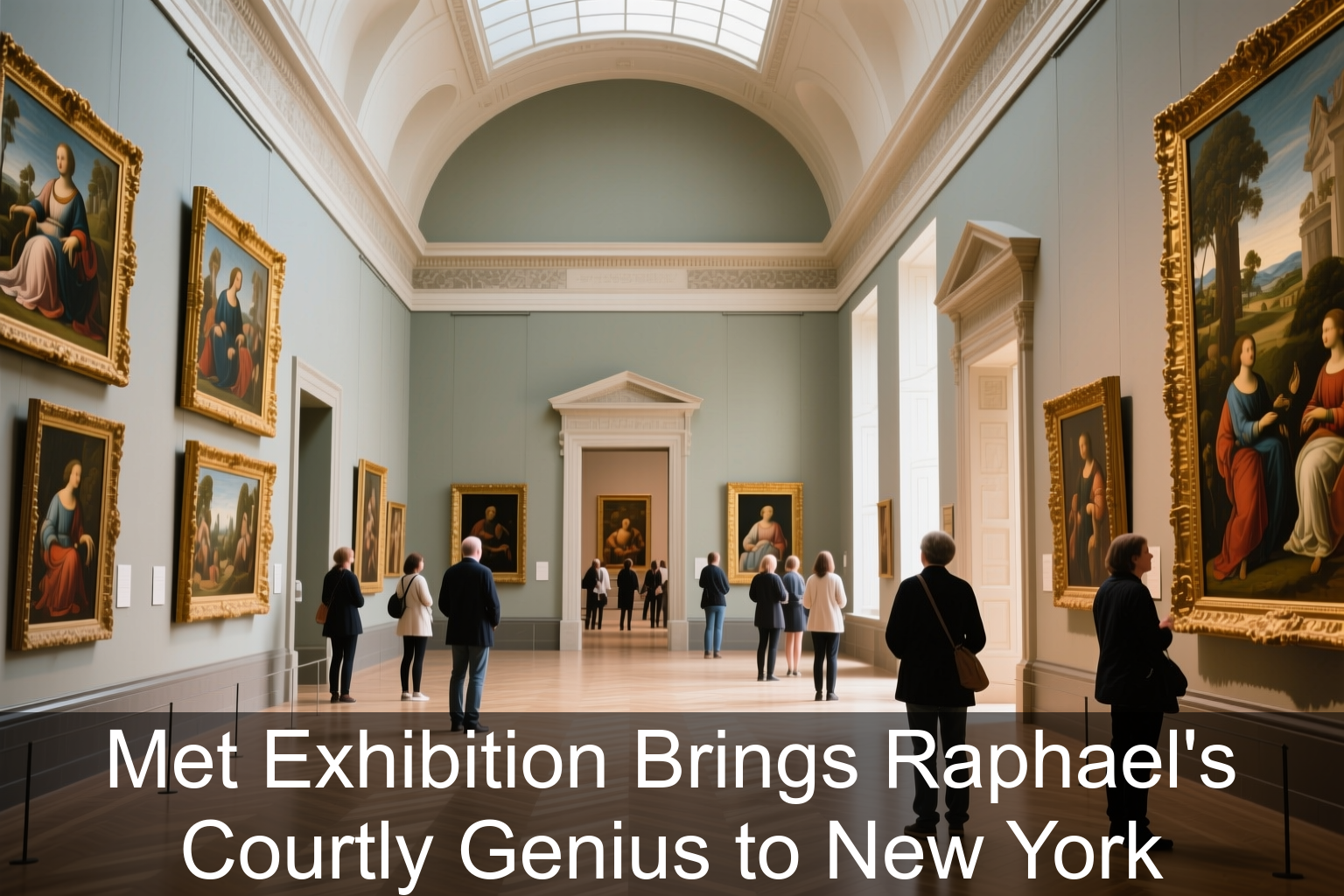
New York is hosting a major museum presentation devoted to Raphael, the Renaissance painter whose short life produced an outsized legacy. The Metropolitan Museum of Art’s exhibition surveys the range of his achievement, highlighting how quickly he mastered multiple formats and subjects while refining a distinctive, polished manner that appealed to elites and patrons of his time.
A central theme of the show is Raphael’s evolution into an artist who understood power, status, and public image as clearly as he understood paint. The exhibition emphasizes a “courtier” mode in his work: compositions that feel effortless but are carefully engineered to project composure, intelligence, and authority. That sensibility—art shaped for patrons who expected dignity and persuasion—runs through the galleries and helps explain why Raphael became a preferred visual voice for the influential.
Religious imagery appears as a pillar of the exhibition, including multiple treatments of the Madonna subject. These works demonstrate Raphael’s skill at making sacred scenes approachable without losing their formal gravity. The show presents these Madonnas as more than devotional pictures; they function as demonstrations of craft, rhythm, and emotional calibration, revealing how the artist balanced tenderness with structure.
Portraiture receives prominent attention as well. The exhibition underscores Raphael’s ability to render likenesses that feel psychologically present while remaining restrained and socially legible—an approach that suited the demands of high-status sitters. These portraits are presented as among the most striking achievements on view, conveying character through posture, gesture, and subtle control rather than theatrical effects.
The Met’s installation also makes room for the larger, public-facing dimension of Raphael’s output. Altarpieces and related works point to the artist’s ambition and his capacity to orchestrate complex visual programs meant for communal spaces. Taken together—Madonnas, portraits, altarpieces, and other examples—the exhibition frames Raphael as a “forever” prodigy whose sophistication matured early and whose influence endured.
For visitors, the takeaway is not only the breadth of what Raphael could do, but the coherence behind it: a steady pursuit of clarity, harmony, and persuasion. In an era when cultural institutions often struggle to justify their mission, a show like this offers a straightforward reminder of what museums do best—preserve, interpret, and share enduring achievements without substituting politics for connoisseurship.