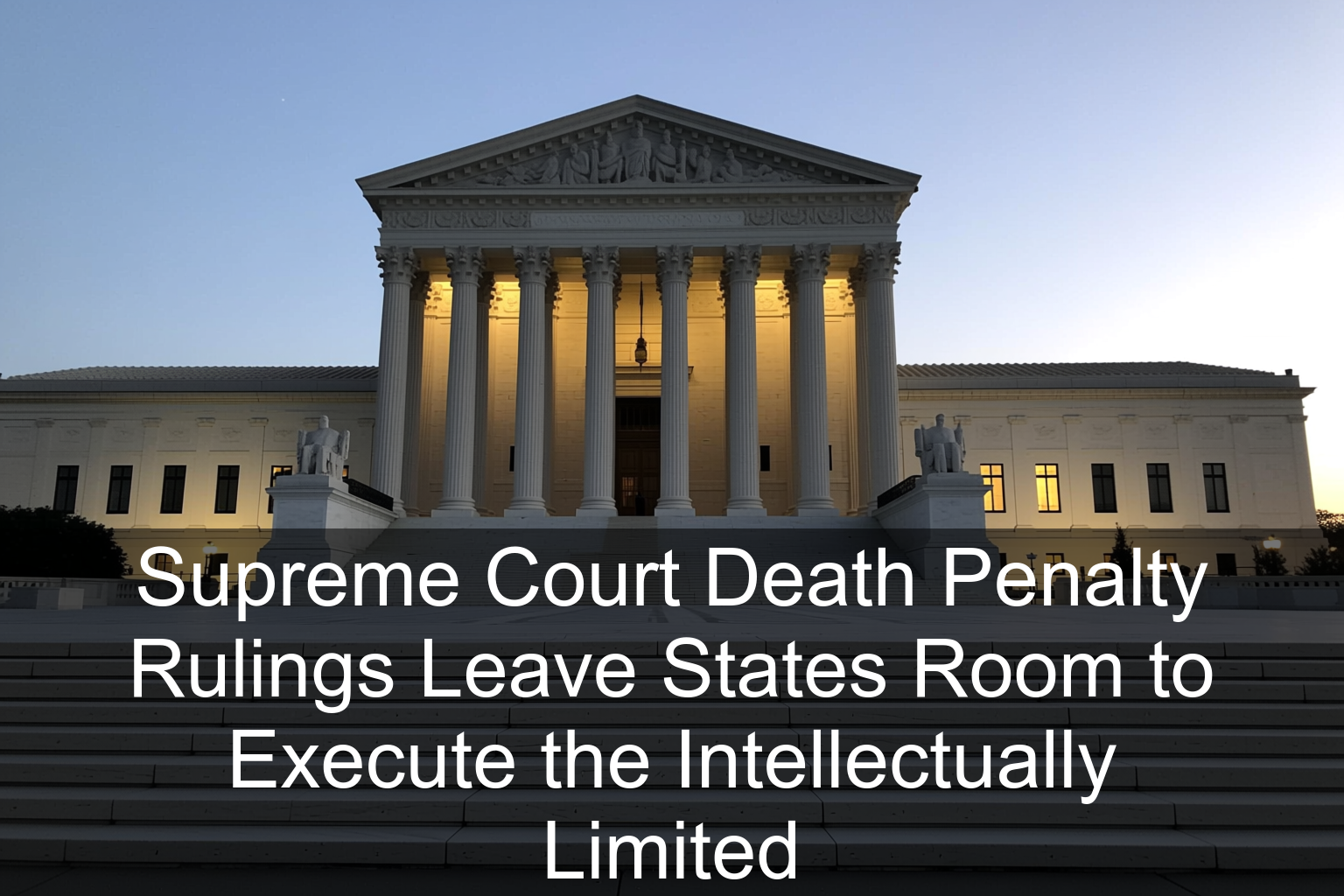
Capital punishment remains constitutionally permissible in the United States, and recent debates over the Supreme Court’s approach highlight how much discretion states still have when seeking executions. Critics on the right argue that, whatever people think about the death penalty as policy, the Court’s Eighth Amendment framework has not created a clear constitutional barrier to executing offenders who have low intelligence but are not legally exempt.
At the center of the controversy is the claim that the Constitution does not categorically prohibit putting to death “dumb guys who kill people,” a blunt formulation meant to separate intellectual limitation from the narrow legal protections that have developed around specific diagnoses or thresholds. From this perspective, the legal system is not designed to excuse murder based on general cognitive weakness, particularly when juries and courts have concluded that a defendant is culpable for a deliberate killing.
The Supreme Court’s death-penalty jurisprudence, as portrayed by commentators taking a conservative or libertarian view, is often criticized for being uneven and heavily dependent on shifting judicial standards rather than stable constitutional text. The result, they contend, is a system that leaves states navigating complex rules while still permitting executions in cases that some advocates would prefer to remove from the table through broader constitutional interpretation.
Supporters of a tighter reading of the Eighth Amendment emphasize that the Court’s role is not to impose a national moral judgment about who is “too limited” to execute beyond the categories already recognized in law. They argue that decisions about punishments, including whether the death penalty should exist at all, are principally questions for legislatures and voters, not for judges to resolve by expanding constitutional doctrine.
In that view, the current landscape produces a harsh reality for defendants with low intelligence who nonetheless fall outside formal exemptions: they can still face capital sentences and, ultimately, execution. The continuing dispute is less about whether the death penalty is allowed in general and more about how far constitutional protections extend—and whether the Court should keep drawing and redrawing lines that determine who lives and who dies.